



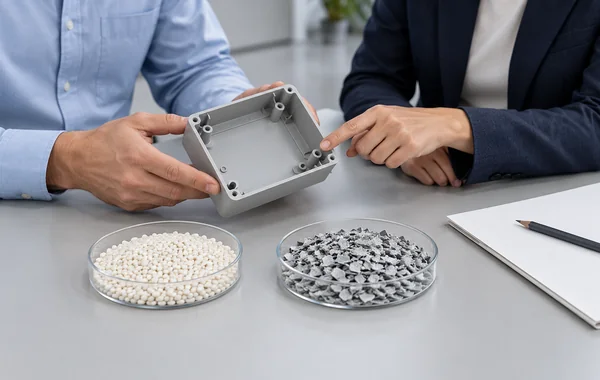
Regrind in Injection Molding: What Buyers Should Agree Before Production
Allow regrind in an injection molding order only through an agreed material specification: identify the resin, the permitted source of recovered material, the amount allowed, and the evidence needed to approve the resulting parts. The quotation should state whether production will use only the specified virgin resin or an approved mixture. A sample alone does not record that agreement.
This guide is for OEM buyers and engineers ordering molded components. It explains what to agree with the supplier before production, not how to set a molding machine. It does not establish a safe percentage for every material or approve a recycled-content claim.
Define what the supplier means by regrind
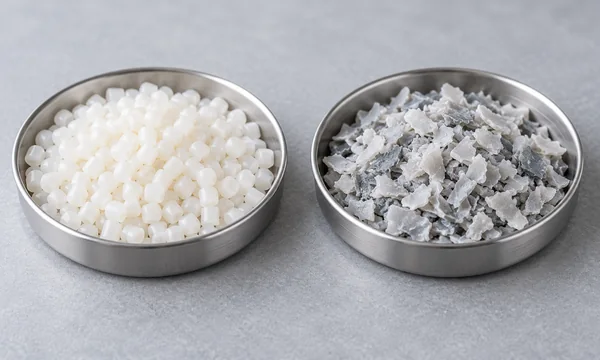
A supplier may propose returning ground sprues or runners to its own molding process. Another proposal may involve buying a separately supplied recycled compound. These are different material routes and should not share one vague approval such as “recycled plastic accepted.”
Begin with the actual source, supplier, grade and processing history. Where the team uses terms such as virgin, regrind, post-industrial or recycled compound, define what each means in the order. Put that definition where both purchasing and the molder can refer to it.
| Proposed route | Buyer decision | Do not assume |
|---|---|---|
| Specified virgin material | Identify the grade, color formulation and whether any recovered molding material is permitted. | A grade name alone records a virgin-only agreement. |
| Reuse of identified molding scrap | Define its origin, permitted reuse, handling controls and agreed limit. | Approval covers every reject or scrap bin. |
| Purchased recycled compound | Review the supplier’s named grade and supporting evidence as a material proposal. | Permission to reuse internal runners approves an outside material. |
Do not confuse this decision with choosing ABS rather than PC/ABS. The ABS versus PC/ABS guide addresses material selection for enclosure requirements. Regrind approval concerns the feedstock used after that material decision.
Agree the source before negotiating a percentage
Ask the supplier to describe the proposed recovered-material stream. Does it come from the same grade and color? Which operations generate it? Is it kept separate from other jobs? Can the supplier connect it to the production material and identify what is excluded?
Record the answers in the material agreement:
- Full resin manufacturer and grade, color reference, reinforcement and approved additives.
- The specific source of material eligible for reuse.
- Excluded material, including unidentified, mixed or contaminated scrap.
- The permitted amount and how the supplier controls and records it.
- The applicable handling instructions and responsibility for reviewing changes.
- The part-level evidence required before production release.
Ask explicitly about painted, printed or assembled rejects rather than treating every rejected part as equivalent to a clean runner. If its source is unknown, request clarification before approval.
For a virgin-only requirement, have the supplier acknowledge that condition in its quotation. If reuse is proposed later, treat it as a material change requiring review, not an unrecorded way to meet the original price.
Do not borrow a percentage from another resin
BASF’s Ultramid product brochure, in its recovery guidance, says the permissible amount depends on the grade, molded part and requirements and should be established through trials. It also identifies cleanliness, drying and prior thermal degradation as relevant conditions. This is material-family guidance, not a universal allowance.
Put the proposed limit beside the exact material and approval evidence. A percentage without that context cannot explain whether the mixture is suitable for a snap, a loaded bracket or a cosmetic cover.
Ask the technical owner which requirements could be affected and what evidence would resolve the question. If the part has safety or customer-specific material restrictions, have the responsible team review those separately. A general processing recommendation does not override the product’s approved construction or purchasing specification.
Approve parts made with the proposed production mixture
Record the material condition used for sample approval. A sample made under one condition should not silently become the reference for a different production mixture.
Covestro’s Texin 990A guidance illustrates why the details matter: its conditions address material cleanliness, blending and drying, and it calls for finished-part evaluation. It also cautions about third-party regrind with uncertain processing history. These are conditions for a named material, not a claim that Zenbot supplies that grade or that its allowance applies to other plastics.
Before a trial, agree what it must demonstrate. Identify the part revision, material route, mold or cavity identification where relevant, samples and planned checks. Ask the supplier to record the proposed mixture used, rather than only writing the polymer family on a sample bag.
Separate functional and cosmetic decisions
List the requirements that matter to this component: critical fits, assembly behavior, loaded features and any specified performance checks. Keep appearance acceptance separate. A satisfactory color match cannot establish that a fastening feature meets its requirement; a fit check cannot approve every visible surface.
Use the existing molded-part appearance guide for cosmetic references and viewing conditions. Do not replace the agreed acceptance plan with an informal statement that the trial parts “look the same.”
If the trial does not represent the intended production condition, record the difference and the remaining work. State which requirements have been accepted and which still need verification.
Make the agreement usable on repeat orders
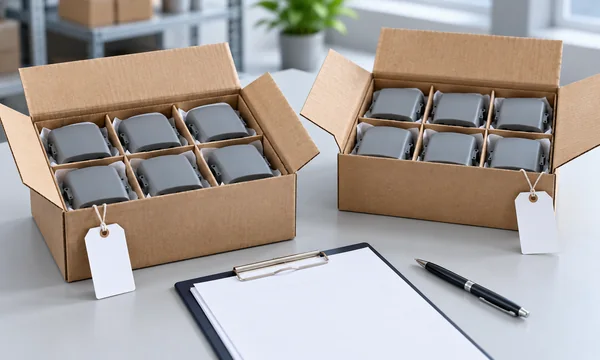
Purchasing, the supplier and receiving need to refer to the same approved material specification. Connect it to the part number, revision and order. Decide which records accompany delivery and which remain available from the supplier.
Depending on the project, the agreed record set may include the material supplier and lot references, recovered-material source, blend or production-batch records, applicable approval and acceptance results. These are proposed purchasing controls, not a claim that every order must use an identical certificate format.
Ask how a proposed change will be identified before use. Relevant changes can include a different resin source, grade, color formulation, recovered-material stream or permitted amount. Name who approves the change and how the affected production quantity will be identified.
When receiving evidence is missing, first establish what is unknown. Keep affected material identified while the supplier reconciles the records. A missing record and a demonstrated material failure are different findings; neither should be hidden behind a generic “material OK” statement.
Keep reuse permission separate from environmental claims
UL Solutions’ recycled-plastics guidance distinguishes in-house molding regrind from material sent to another molder within its evaluation framework. It also explains that its mechanically recycled plastics Component Recognition does not validate the type or percentage of recycled content. Content-claim validation is a separate question.
If the purchasing goal includes a recycled-content claim, specify the claim and evidence needed for the intended product and market. Do not turn a shop-floor blend target into a published environmental statement. Likewise, the existence of a material document or recognition does not establish that this finished component or assembled product is certified.
What to send Zenbot for review
Zenbot’s oferta de moldeo por inyección states that resin grade, color, additives and project requirements are confirmed during review. It does not establish a standard regrind allowance or guarantee a particular recovered-material route.
Send the current drawing and CAD, quantity, exact material requirement, proposed reuse condition and required acceptance evidence. Flag any material decision that still needs review. Ask Zenbot to review the proposal and confirm the available scope, responsible parties and exclusions before placing the order.
Preguntas frecuentes
1. What is regrind in injection molding?
Regrind is material recovered by grinding previously processed plastic, such as molding sprues and runners. For a purchase specification, identify its exact source and permitted reuse route rather than relying on the word alone.
2. Is there a standard percentage that is safe for every molded part?
No universal percentage establishes suitability for every grade and application. Agree the permitted amount with the responsible technical team using the material supplier’s guidance, applicable requirements and representative part evaluation.
3. Does specifying the resin grade automatically allow regrind?
Do not assume permission either way. Put the agreed virgin-only or permitted-regrind requirement into the controlled material specification and quotation. The same resin designation does not document the production mixture.
4. Is purchased recycled resin the same as the molder’s own runners?
No. They have different supply and processing histories. Identify the purchased material by its supplier and grade, and review its evidence separately. Approval for an internal scrap stream should not become approval for an external replacement.
5. Can an approved virgin-resin sample approve later parts containing regrind?
Not by itself. Record the material condition used for sample approval, then assess a proposed change against the product requirements. Agree the additional trial or verification needed before releasing that change.
6. Which production records should a buyer request?
Agree records that connect the order and part revision to the approved material specification, material sources, production batch and relevant acceptance results. Where blend records are required, define their content and retention before placing the order.
7. Does a safety recognition verify a recycled-content claim?
Not necessarily. UL Solutions distinguishes its mechanically recycled plastics Component Recognition from validation of recycled-content type and percentage. Check the scope of the actual evidence before making a claim about a product.
8. Does Zenbot have a standard regrind allowance for every injection molding order?
No blanket allowance is established here. Send the proposed material requirement and part details to Zenbot for project review. Confirm the available material route, responsible processing parties and agreed acceptance evidence in the quotation.

Acerca del equipo de Zenbot
El equipo de Zenbot elabora recursos sobre fabricación y compras para Zenbot China. Nuestras guías abarcan mecanizado CNC, fabricación de chapa metálica, impresión 3D, moldeo por inyección, PCBA y preparación de solicitudes de presupuesto, y ayudan a los equipos de ingeniería y compras a comparar opciones y definir los requisitos del proyecto. La viabilidad técnica, las especificaciones, los precios y los plazos de entrega requieren confirmación para cada proyecto.