



Sheet Metal Grain Direction: What Buyers Should Specify Before Cutting
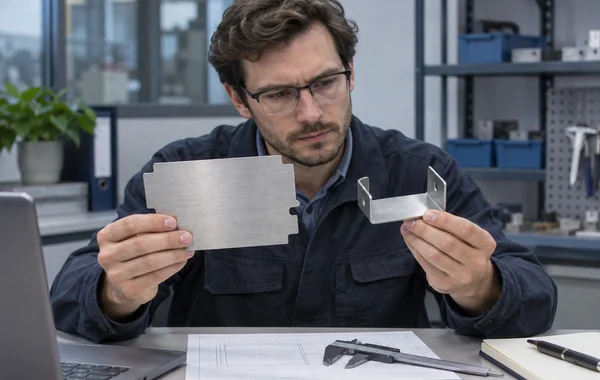
For sheet metal parts, specify the rolling direction needed for forming separately from the visible brushing direction needed for appearance. Show both against named faces and bend lines, and ask the fabricator to confirm which rotations are permitted when arranging blanks on the sheet. A note that says only "grain direction" leaves too much open.
This matters when a bent bracket has a demanding corner, when adjacent enclosure panels must look consistent, or when a repeat order will be cut from a different sheet layout. Before ordering, confirm the required orientation and whether the proposed material and forming route can meet it. Record the agreed requirements with the order.
Two meanings of grain direction need two different notes
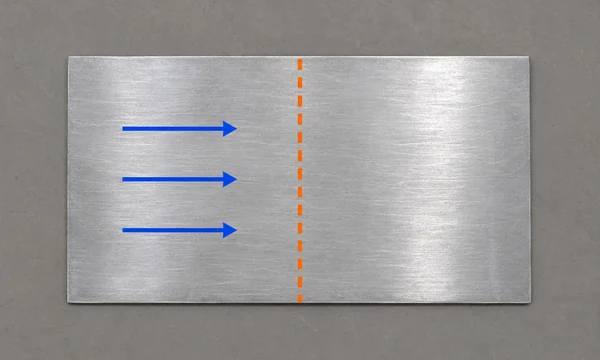
Rolling direction describes the orientation established when the metal stock was rolled. A brushed finish describes directional marks on the surface. They can point the same way, but a visible pattern is not sufficient evidence of the stock’s rolling direction.
SSAB’s bending recommendations explain why material orientation matters and require the steel grade, thickness and direction relative to rolling to use its tables. Those recommendations apply to SSAB products; they are not a universal bend-radius table for other steel or aluminum. Separately, Protocase describes a grained finish produced by brushing. These are different manufacturing questions, even when both are called "grain."
| Requirement | What to identify | Evidence to agree |
|---|---|---|
| Rolling direction for forming | Stock direction relative to the critical bend line | Material identification and how orientation is retained through cutting |
| Visible finish direction | Brush direction on a named visible face | Approved appearance reference in the installed orientation |
| Blank placement | Permitted rotation and whether the blank may be flipped | Supplier confirmation that the production layout follows the drawing |
| Finished acceptance | Required geometry and appearance after forming and finishing | Agreed first-article results and any approved deviations |
Start with the bend that needs the most review
Identify the bend lines on the flat view and link them to the formed drawing. For each critical bend, state the material grade and condition, thickness, required inside radius and finished angle. Ask the fabricator to evaluate the bend with the proposed stock and tooling. Do not borrow a radius from another material merely because the thickness matches.
Orientation alone does not establish whether a bend is feasible. Outokumpu’s stainless forming guidance notes that springback varies among steel groups and that grade or thickness changes can require machine adjustments in roll bending. Review material changes with the fabricator, even when the replacement sheet looks similar.
When the part has bends in two directions
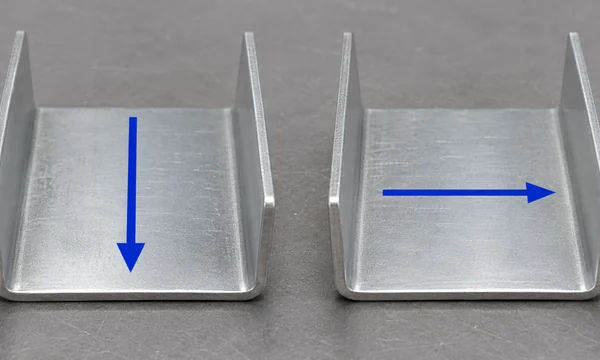
A rectangular tray can have bend lines running in two perpendicular directions. One stock orientation cannot place both sets of lines perpendicular to the rolling direction. Mark the bends that control function and ask for a workable plan for the whole part. Depending on the design, that discussion may involve a radius change, another material condition, a revised construction or a representative forming trial.
Do not resolve this conflict by silently changing the flat pattern. Engineering should approve changes that affect fit, strength or appearance before purchasing releases the order. Zenbot’s guía DFM de carcasas de chapa metálica covers the broader review of bend access, relief, holes and hardware; orientation adds a specific constraint to that review.
Make the nesting restriction visible before the quote
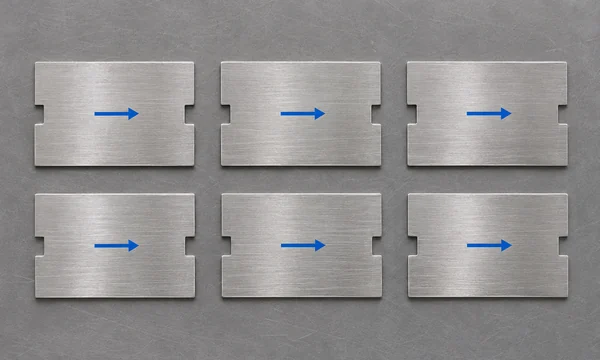
Nesting is the arrangement of flat blanks on a sheet before cutting. Rotating a blank can improve material usage, but it also changes the relationship between the part and the sheet direction. A cheaper layout is not equivalent if it drops a required orientation.
Supplier policies differ. SendCutSend’s published FAQ says its service does not guarantee a specific grain direction and arranges parts for material efficiency. That is a statement about that service, not a rule for all fabricators. It shows why buyers should check whether an orientation requirement can actually be accepted before comparing prices.
- Identify the face used to read the direction arrow; a top view and an underside view should not be confused.
- State whether rotation is unrestricted or subject to an approved relationship with the stock direction.
- Specify whether flipping the blank is permitted, particularly where faces have different surface requirements.
- Ask how orientation will be identified after the sheet is divided into blanks or retained as remnants.
- Have the quote identify any extra material or processing requirement instead of hiding it in an unspecified "standard finish."
Do not add a restriction when the design does not need one. If engineering accepts several orientations and appearance is unaffected, record that flexibility. Conversely, do not let a production planner remove a required restriction just because it limits sheet yield.
Handle visible panels as an assembly, not isolated samples
For a brushed enclosure, name the cosmetic faces and show the desired lines in the installed orientation. A drawing arrow on a loose panel can be interpreted correctly yet still produce an unwanted appearance when that panel is turned during assembly. Include the adjacent lid, front panel or door in the review.
Agree how an appearance sample will be viewed, including which surfaces must match and which marks are unacceptable. A photograph can communicate the intended direction, but use an agreed physical reference where the visual acceptance decision needs one. Keep finish approval separate from the evidence used to establish rolling direction.
If the desired brush pattern conflicts with the forming route, ask the supplier to propose a finishing sequence or design change for review. Do not assume brushing after forming is always accessible, economical or suitable. Equally, applying a new surface pattern should not be presented as changing the material’s rolling history.
Release a direction-controlled drawing and acceptance record
The following is a proposed buyer checklist, not a standard form or a statement of Zenbot’s internal procedure. Use the parts that matter for the component and agree them with the fabricator.
- Identify the material. Record the grade, condition or temper where applicable, thickness and approved stock requirements.
- Separate the arrows. Label rolling direction and visible finish direction explicitly rather than using one unexplained arrow.
- Locate the constraints. Reference the critical bend lines, named faces and finished drawing revision.
- Record the layout decision. Confirm allowable rotation, flipping and any restrictions on using remnants.
- Define acceptance. Agree the formed dimensions, bend condition, appearance reference and any further inspection required by the application.
- Control deviations. Require review before changing a restricted orientation, material condition or agreed forming route.
A hypothetical enclosure review
Suppose a buyer orders a brushed stainless enclosure with a removable front panel. The visible lines must align when assembled, while a tight return flange needs a forming review. The buyer supplies an assembly view showing the finish direction and a separate flat view identifying the critical bend and required stock relationship. The fabricator checks whether both requirements can be met together and identifies any proposed change before cutting.
The first article is then checked for the agreed geometry, bend condition and assembled appearance. This is an illustrative review sequence, not a Zenbot customer case or evidence that a particular radius is feasible.

Keep the decision with repeat orders
A sample establishes what was accepted, but it does not tell a later planner which stock orientation produced it. Keep the drawing revision, material identification, layout restriction and first-article disposition together. Ask what changes require another review, especially a different stock source, condition, thickness, forming route or restricted blank orientation.
If direction history is missing, do not infer it from a brushed surface or an old photograph. Ask the supplier what can be established and have engineering decide whether additional evidence or a new trial is needed. The first-article inspection guide can support the broader release discussion, subject to the exact records agreed for the order.
Send an RFQ that distinguishes function from appearance
La oferta de fabricación de chapa metálica covers project-reviewed cutting, bending, welding and finishing requirements. Send the formed model, flat view if available, material and thickness, quantity, critical bends and separate direction notes. Include the appearance reference and state which decisions remain open.
Ask for confirmation of the proposed orientation and finishing route, any effect on the quotation, and the evidence needed before production release. Material availability, tooling suitability, tolerances and timing require project-specific confirmation. Confirm these items before releasing the order.
Preguntas frecuentes
1. Is rolling direction the same as a brushed finish direction?
No. Rolling direction belongs to the stock’s manufacturing history. Brushing creates a visible surface pattern. Specify them separately and do not use the brush marks alone to establish rolling direction.
2. Should every bend line be perpendicular to the rolling direction?
Do not apply that as a universal instruction. Ask the fabricator to assess the actual grade, condition, thickness and geometry using applicable material guidance. A part with perpendicular bend lines may need a compromise or a design change approved by engineering.
3. Can a supplier rotate my blank to save material?
Only within the accepted drawing and quotation requirements. If direction matters, show the restriction before the layout is prepared and confirm whether the supplier can support it. If orientation is unrestricted, state that clearly.
4. What if the enclosure has bends running in two directions?
Identify the bends that need particular review and have the fabricator evaluate the complete part. One sheet orientation cannot put two perpendicular bend lines both perpendicular to rolling direction. Any proposed radius, material or construction change needs approval.
5. Will brushing a formed part fix an unsuitable rolling direction?
No. Brushing can change the surface appearance, not the stock’s rolling history. A proposed finishing operation also needs review for access and its effect on the finished part.
6. How should matching visible panels be specified?
Show the desired finish direction on named faces in the assembled orientation. Agree which panels must match, the appearance reference and the viewing conditions used for acceptance. Keep those requirements separate from forming-direction controls.
7. Does an approved sample establish direction for every reorder?
Not by itself. Retain the approved drawing, material identification and orientation restrictions with the sample disposition. Agree which changes require another review so a new layout or stock condition is not silently treated as equivalent.
8. What should I send for a direction-controlled sheet metal quote?
Send the formed model, drawing revision, material and thickness, quantity, critical bends and separate rolling-direction and finish-direction notes. Include appearance references, permitted layout flexibility and the acceptance records you need.

Acerca del equipo de Zenbot
El equipo de Zenbot elabora recursos sobre fabricación y compras para Zenbot China. Nuestras guías abarcan mecanizado CNC, fabricación de chapa metálica, impresión 3D, moldeo por inyección, PCBA y preparación de solicitudes de presupuesto, y ayudan a los equipos de ingeniería y compras a comparar opciones y definir los requisitos del proyecto. La viabilidad técnica, las especificaciones, los precios y los plazos de entrega requieren confirmación para cada proyecto.