



PCBA Packaging for Shipping: ESD Protection and Receiving Checks
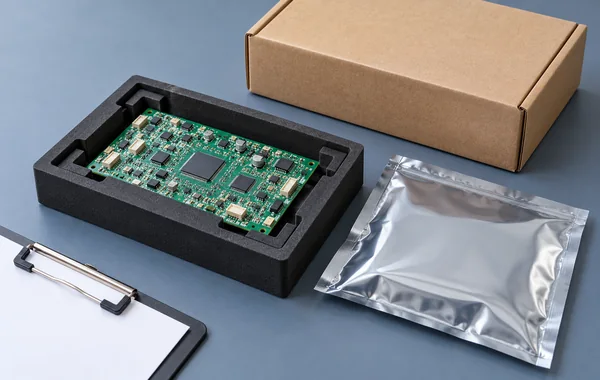
PCBA packaging needs an ESD protection plan and a mechanical packing layout. Identify the assembly on the package, agree any storage controls, and give receiving staff a clear inspection and release procedure. A bag described only as “anti-static” does not tell the buyer whether the complete package provides discharge shielding, adequate support or any moisture barrier.
This guide concerns completed printed circuit board assemblies shipped from an assembler to an OEM or warehouse. Sending loose components to an assembler is a different task, covered in our turnkey versus consigned assembly guide.
What a PCBA packaging specification should control
Use the following review points to build a project-specific packaging specification. Start with the actual assembly and its destination. A small board with low-profile parts and a large board with projecting connectors may need different supports, even when their electrical protection requirements are similar.
| Decisión | Qué definir | What to review before shipment |
|---|---|---|
| ESD protection | The protection required while the board is outside an ESD protected area. | Identified packaging materials and evidence for the relevant protective properties. |
| Mechanical support | Board support points, clearances and permitted contact areas. | A representative packed assembly, including tall parts and connector projections. |
| Moisture and storage | Expected storage conditions and any assembly-specific moisture controls. | The agreed storage, closure and reopening instructions, where required. |
| Identification | Part number, revision, quantity and the lot or serial references required by the order. | Labels that match the enclosed boards and accompanying records. |
| Transport and receiving | Shipment route, package quantities and the process for handling discrepancies. | The approved pack configuration, any agreed test report and receiving instructions. |
Specify ESD protection outside the controlled work area
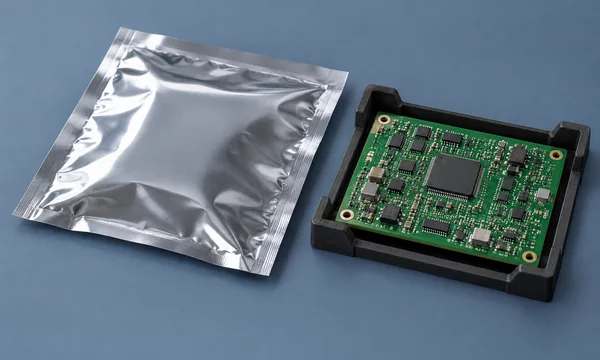
An ESD protected area, or EPA, is a controlled handling environment. The EOS/ESD Association’s packaging guidance distinguishes materials used inside an EPA from packages used outside it: low-charging and conductive or dissipative properties matter within the controlled area; discharge shielding is also needed outside it.
Bag colour is not a specification. Ask which materials or complete system provide the protection, what evidence supports that choice, and how the package must be closed. Different layers can have different functions.
A packaging supplier’s technical sheet should separate properties rather than rely on a broad sales description. For example, SCS documents discharge shielding and dissipative surfaces separately for one of its bag products. Use the technical sheet as an example of documentation to request; suitability still depends on the assembly.
Keep the load off components and connectors
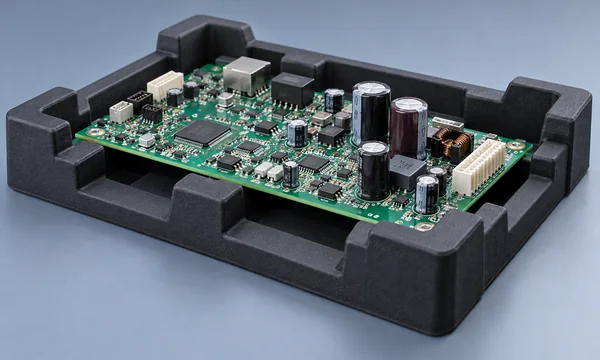
Review the board in its package. Where is it supported? Can it slide, or contact another assembly when the carton is handled? Do not approve a layout that relies on an unreviewed connector, switch or tall component to carry the packing load.
- Identify board edges or other areas that may contact the support.
- Leave clearance around projecting connectors, pins, switches and components on both sides.
- Separate boards so that one assembly cannot press or rub against another.
- Check that the chosen closure can be completed without forcing the board into the package.
- Review the complete combination of inner protection, supports and outer carton, not each item in isolation.
Use a representative assembly for this review. A flat blank board cannot reveal interference with fitted components. If a dummy is used, record what it reproduces and what still needs checking on the actual PCBA. Avoid setting a universal cushion thickness or number of boards per carton without considering the assembly and distribution route.
Decide moisture protection separately
Do not assume that static shielding also establishes moisture-barrier performance. If moisture protection is required, identify the relevant material specification and the storage and closure conditions it depends on.
Texas Instruments describes moisture sensitivity level, or MSL, in relation to moisture damage during reflow. That component-level classification is not, by itself, a finished-PCBA shelf-life specification. TI’s packaging and reliability FAQs also show that semiconductor storage decisions depend on the device, packaging and storage conditions.
For completed boards, agree the storage period and environment, any subsequent soldering or rework, and the assembly’s material limitations with the responsible engineering team. Where dry packing, desiccant or a humidity indicator is required, define the procedure and interpretation for that application. Do not apply a generic baking instruction to a populated board: the assembly needs its own review.
Approve a representative pack before the production shipment
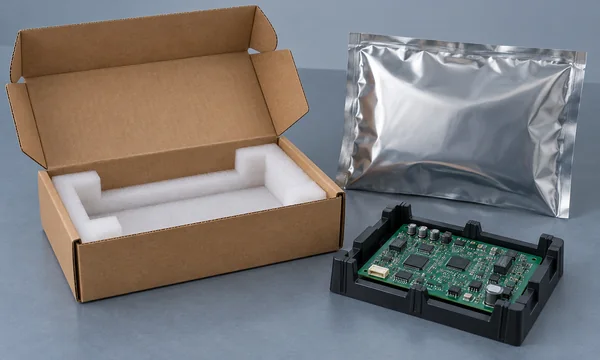
Give the approved packaging configuration an identifier or revision so that purchasing and receiving can refer to the same arrangement. Include enough detail for the packing team to reproduce the approved arrangement:
- Assembly identification and the quantity in each inner package and outer carton.
- Packaging material references, supports and closure method.
- A drawing or annotated photographs showing orientation, clearances and contact areas.
- Required labels and their relationship to the enclosed lot or serial numbers.
- Storage, opening and repacking instructions where these affect protection.
- Any transport test, acceptance criteria or shipment trial agreed for the order.
Match transport validation to the real distribution route. The International Safe Transit Association’s selection guidance emphasizes how packages are handled, stored and transported, and the purpose of the test. A screening exercise and a test intended to represent a particular shipment environment answer different questions.
If testing is required, agree the procedure, representative assembly, pack configuration, sample selection and pass criteria before the test. Record any substitutions. A report for a different board or packing arrangement should not be treated as proof for this shipment without a review of the differences. Ask Zenbot to confirm any requested transport-testing scope and supporting report in the quotation.
Give receiving a clear release and discrepancy process

Receiving needs to know what to check before opening a package and what requires a controlled handling area. Agree that sequence with the receiving site before dispatch.
- Check the delivery reference, carton count and visible condition before unpacking. Record damage or unexpected openings.
- Match the inner-package labels to the order, assembly revision, quantity and required lot or serial records.
- Move the assembly to the appropriate ESD-controlled handling environment before exposing it.
- Check the board and its supports for displacement, contact marks, bent projections or other discrepancies against the agreed criteria.
- Segregate questionable material, retain the packaging and photographs, and request disposition from the responsible supplier and engineering contacts.
An undamaged carton or a normal visual inspection does not prove that a board has avoided every electrical fault. Keep the agreed electrical and functional acceptance checks separate; our PCBA inspection and testing guide explains their different coverage. Do not silently repack a suspect board and release it into production.
What to send for a packaging review
Send the assembly outline and component profile, quantities, planned delivery route, expected storage conditions and receiving arrangements. Mark sensitive projections and any areas that must not contact packaging. Include the identification fields and acceptance records your receiving team needs.
Include these requirements with the released electronics package described in our lista de comprobación de archivos para ensamblaje de PCB. Ask Zenbot to review the requested packaging and delivery scope alongside the assembly work and confirm what is included in the quotation. Material selection, special storage controls and any testing must be agreed for the specific project.
Request a PCBA packaging review with your assembly and shipping requirements. Confirm the proposed packaging scope with Zenbot before placing the order.
Preguntas frecuentes
1. Is an anti-static bag enough for shipping a PCBA?
No. Ask for the specified protective properties and closure instructions, then check the mechanical support separately. A general label does not establish that the complete package is suitable for the assembled board.
2. Does every packaging layer need to provide discharge shielding?
Not necessarily. Different layers can provide different functions within a protective system. Ask which part of the complete package provides shielding and which materials contact or support the assembly, then review the evidence and intended use together.
3. Can several assembled boards be stacked in one package?
Only with an agreed arrangement that keeps the assemblies separated and supported without loading components or connectors. Review a representative packed set and the permitted quantity; do not assume that an individual bag prevents mechanical contact damage.
4. Does every finished PCBA need vacuum packing?
Not automatically. Review the assembly’s storage conditions, materials and any later processing. If moisture protection is needed, agree the packaging and closure procedure for that application; vacuum packing alone does not define it.
5. Does component MSL define the shelf life of a completed board?
No. Component moisture sensitivity level concerns susceptibility to moisture-related damage during reflow. It does not, by itself, define the storage life of a populated board. Obtain assembly-specific storage and later-processing instructions where these are relevant.
6. What should the package label identify?
Use the fields required by the order and receiving process, typically the assembly part number, revision, quantity and applicable lot or serial references. Keep those identifiers consistent with the enclosed boards and accompanying inspection or test records.
7. What should receiving do with a torn bag or damaged carton?
Record the condition, retain the packaging and segregate any potentially affected assemblies. Follow the agreed handling precautions and obtain supplier or engineering disposition before release. Repacking alone does not establish that the contents remain acceptable.
8. Does a transport test replace electrical or functional testing?
No. A transport test evaluates the agreed packaged-product configuration under its defined conditions. Electrical and functional tests answer different acceptance questions. Specify what must be checked before and after transport testing and for routine receiving.

Acerca del equipo de Zenbot
El equipo de Zenbot elabora recursos sobre fabricación y compras para Zenbot China. Nuestras guías abarcan mecanizado CNC, fabricación de chapa metálica, impresión 3D, moldeo por inyección, PCBA y preparación de solicitudes de presupuesto, y ayudan a los equipos de ingeniería y compras a comparar opciones y definir los requisitos del proyecto. La viabilidad técnica, las especificaciones, los precios y los plazos de entrega requieren confirmación para cada proyecto.