




Material Certificates for CNC Parts: How to Check Heat and Lot Traceability
Check material certificates for CNC parts in two steps: compare the reported material and condition with the purchase requirements, then follow the identifiers connecting the report to the delivered parts. The supplier’s shipment lot, machining work order and original material heat may use different numbers. Ask for the records that explain those connections.
A PDF naming the correct alloy leaves a practical question: which stock was actually machined? For metal CNC parts, the answer needs to survive stock cutting and outside processing, even when one shipment contains several material lots.
Decide which documents the order needs
Material test report (MTR), mill test certificate (MTC) and certificate of conformity (CoC) are common document labels. Read what each document certifies, who issued it and which material or parts it identifies. A document headed “Certificate” may contain a declaration, test data or both.
| Document | What to look for | What it does not establish by itself |
|---|---|---|
| Material test report or certificate | Material specification, condition, material identifier and applicable test results | That the reported material was used for the delivered CNC parts |
| Supplier certificate of conformity | Issuer’s declaration, referenced order and parts, scope and supporting-record references | The underlying material test values, unless included or attached |
| Process certificate or report | Specified treatment, processed parts or batch and required results | Conformity of unrelated material or dimensional requirements |
| Dimensional inspection report | Identified parts and measured drawing characteristics | Material composition, temper or source |
Stäubli’s MTC explanation lists typical steel-certificate information such as the heat number, material identification, chemical composition and mechanical properties. The records needed for your order depend on its material specification and purchasing requirements.
State the required document type and applicable standard in the RFQ. Also agree whether original mill reports must accompany the shipment or remain available on request. Do not assume that a general request for a “material certificate” means a particular EN 10204 document type.
Match the material condition, not only the alloy name
Check the report against the full designation on the order: grade, condition or temper, applicable specification and stock form where controlled. Review the reported tests against that requirement, including units. Ask the responsible materials engineer to resolve unfamiliar designations or inconsistent results.
An example appears in Brown Metals’ certificate guide. A melt mill and a conversion mill can issue different records for the same material history. Later rolling changes dimensions and mechanical properties, so an earlier melt record may not describe the final supplied condition. Its guide shows how supplier references, heat number, alloy, temper and thickness connect the records.
That is a supplier-specific example, not a universal certificate layout. Look for equivalent identifying fields, and ask for an explanation when the documents use different terminology. If the CNC parts receive heat treatment after machining, the original stock certificate alone does not document that later operation.
Follow the stock through cutting and machining
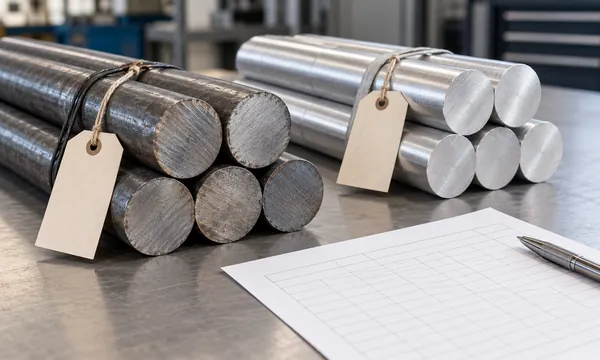
A heat number identifies a material melt; a machining lot or shipment lot identifies a different grouping. One heat can feed several jobs, and one order can use stock from several heats. An internal work-order number can preserve the connection, provided the records show what it refers to.
Before manufacture, ask how the supplier will keep the required identity when a bar or plate is cut into blanks. Include remnants that may return to storage. If the original marking disappears during cutting or machining, agree how labels, containers or production records will preserve the link.
- Which incoming stock identifier connects to the material report?
- How are cut blanks and reusable remnants identified?
- Which job record connects those blanks to the finished batch?
- How are different material lots kept distinguishable when they share a work order?
Choose the identification level with the supplier based on the order requirements and how the parts will be handled. Permanent marking on every part is not always necessary. If parts cannot be marked, define how their packaging or other controlled identification remains associated with them.
Keep outside processing in the same record trail
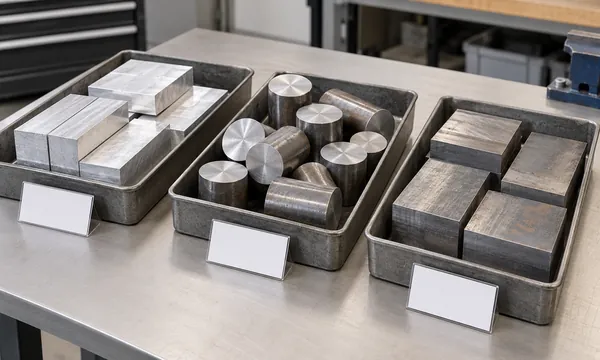
Parts may leave machining for anodizing, plating, passivation or heat treatment. The processor may assign a new batch number. Request the connection between the dispatched parts, the processor’s record and the returned batch, rather than expecting every organization to use the same identifier.
Agree what must happen if a batch is split, combined or partially reprocessed. A finish certificate that names only a coating process leaves the receiving team unable to identify which parts it covers.
CIRCOR Hale Hamilton’s supplier quality manual is an example of a buyer specifying material traceability and separate material and process documentation for deliveries. Those are that buyer’s requirements. Your purchase order should define its own documentation scope with the supplier.
Make a mixed-lot shipment readable at receiving
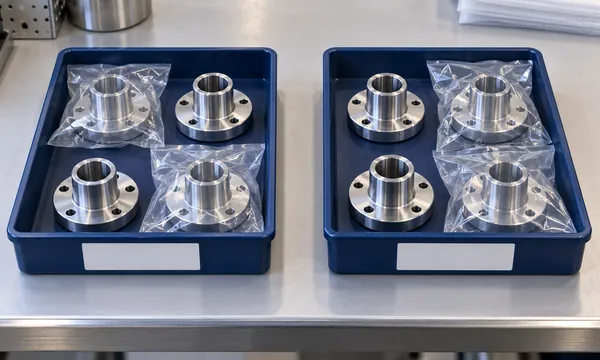
If the order permits several material heats, ask for a shipment summary that connects each delivered group to its material evidence. Receiving should not have to guess which certificate belongs to which bag of parts.
The following is a hypothetical mapping, not a prescribed numbering system:
| Delivered group | Production reference | Material reference | Related record |
|---|---|---|---|
| Bag A: 12 parts | Job J42, sublot A | Stock S17, heat H101 | Material report M101; finish batch F8 |
| Bag B: 8 parts | Job J42, sublot B | Stock S23, heat H204 | Material report M204; finish batch F8 |
This mapping works only if the supplier’s records support it and the bag identities remain attached to the correct parts. Confirm that the quantities reconcile with the packing list. Receiving should preserve the separation until the agreed checks are complete and maintain any identification needed during later use.
Handle contradictions before releasing the affected parts
If a label points to one heat and the certificate names another, record the discrepancy. Keep the affected parts identifiable and on hold under the receiving procedure while the supplier investigates. Ask for the missing cross-reference or a corrected document from its issuer, with the correction explained.
Do not replace a missing record with a certificate for similar stock. Additional material testing may answer a defined chemistry or property question, but it does not automatically reconstruct the original source history or every processing step. Agree any proposed testing and its limits with the responsible quality or engineering authority.
Document the final decision, including any authorized concession and the exact parts it covers. This receiving review is separate from first article inspection; an approved first article does not identify the material used in a later shipment.
Specify the evidence package before requesting a quote
Zenbot’s CNC machining service page states that exact alloy, temper, certification, stock condition and traceability are confirmed for each project. Ask which documentation can be supplied for your order.
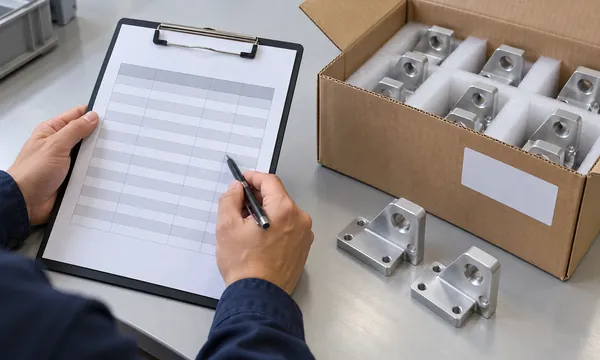
Send the drawing and material specification with the required certificates, identification level, mixed-lot restrictions, outside-process records and delivery-document format. State how long records must remain available and who needs access, if those requirements apply. Use the manufacturing RFQ checklist for the broader purchasing package, then request a project-specific quotation that confirms which records can be supplied.
Frequently asked questions
1. Is a certificate of conformity the same as a mill test report?
Not necessarily. A supplier’s CoC declares conformity within its stated scope. A mill test report provides material information and test results for the material it identifies. Check the contents and referenced evidence rather than relying on the document name.
2. Does a heat number identify the finished CNC production lot?
No. A heat number identifies a material melt. Production and shipment lots can use other numbers. The supplier’s records need to connect those identifiers when the order requires material traceability.
3. Must every CNC part have its heat number engraved on it?
Not automatically. Agree the required identification method before manufacture. Depending on the requirements, controlled packaging or production records may provide the connection. Any marking on the part needs an approved location and method.
4. Can one shipment contain parts from different material heats?
Yes, if the order permits it and the required traceability is preserved. Identify which delivered groups belong to each heat and provide the corresponding records. State any single-heat requirement before stock is purchased.
5. Does a material certificate verify anodizing or later heat treatment?
Only if its stated scope actually covers that operation and the relevant parts. Request the specified process records separately when treatment occurs later, and link them to the delivered batch.
6. Can a material test restore missing traceability?
A test can establish the characteristics it measures for the tested material. It does not automatically prove the original mill, heat identity or complete processing history. Have the responsible authority decide whether proposed testing addresses the missing evidence.
7. What should receiving do when the certificate and label disagree?
Keep the affected parts identifiable and hold them under the receiving procedure. Record the mismatch and request supporting records or an explained correction from the supplier. Release them only through the agreed disposition process.
8. What should I send Zenbot for a material-documentation review?
Send the drawing, full material designation, quantity and required evidence package. Specify certificates, part or lot identification, mixed-heat restrictions, outside-processing records and any retention requirements. Ask for the available scope to be confirmed in the quotation.

About Zenbot Team
Zenbot Team creates manufacturing and procurement resources for Zenbot China. Our guides cover CNC machining, sheet metal fabrication, 3D printing, injection molding, PCBA, and RFQ preparation, helping engineers and purchasing teams compare options and define project requirements. Technical feasibility, specifications, pricing, and lead times require project-specific confirmation.