



SLA vs. SLS vs. MJF: Which 3D Printing Process Should You Choose for Plastic Parts?
Choose stereolithography (SLA) when fine detail and a smooth surface matter, provided a suitable resin meets the part’s working requirements. For nylon housings, clips or fixtures, compare selective laser sintering (SLS) with Multi Jet Fusion (MJF). Both powder processes can suit functional parts, but the material grade, geometry and finished-part requirements should decide the choice.
Start with what the part must do. A cover for an appearance review needs different evidence from a clip that will be opened repeatedly. Zenbot’s 3D printing service includes SLA, SLS and MJF options, with the material, build preparation and inspection scope confirmed after file review.
SLA, SLS, and MJF at a glance
| Decision factor | SLA | SLS | MJF |
|---|---|---|---|
| How the part is formed | Light cures liquid photopolymer resin | A laser fuses selected regions of polymer powder | Fusing and detailing agents control where thermal energy fuses polymer powder |
| Material starting point | A resin formulation selected for the required properties | A qualified polymer powder, often nylon | A qualified thermoplastic powder, often nylon |
| Surface considerations | Fine detail and smooth surfaces; support contacts may need finishing | A powder-based texture; cleaning and optional finishing affect the result | A powder-based texture; color and finish depend on the material and finishing route |
| Build support | Supports are often needed, depending on geometry and orientation | Surrounding powder supports the part, usually without dedicated supports | Surrounding powder supports the part, usually without dedicated supports |
| Useful starting applications | Appearance models, detailed components and functional parts in a suitable resin | Functional prototypes, housings, clips and fixtures in a suitable polymer | Functional prototypes and batches of parts in a suitable polymer |
The manufacturing steps explain some of these differences. Formlabs’ SLA guide describes light-cured resin parts, while its SLS guide explains laser processing in a supporting powder bed. Use the applications to narrow the review, then assess the actual design.
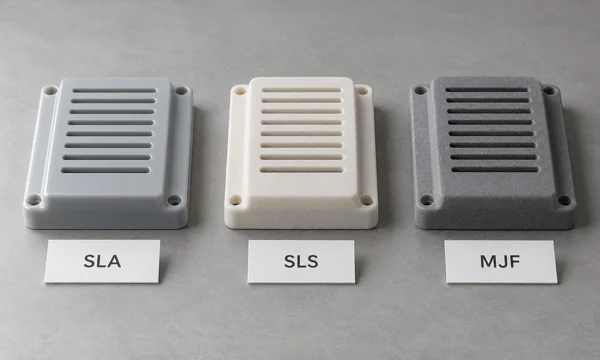
Choose a material grade before comparing strength
Descriptions such as “ABS-like” or “tough” indicate a resin’s intended behavior. They do not establish equivalence to an injection-molded thermoplastic. Engineering resins can support functional testing when their properties match the application.
Polyamide 12, also called PA12 or nylon 12, is used in both SLS and MJF. The shared name still does not establish identical performance. Ask for the exact grade and its technical data sheet, including the conditions used to measure the properties relevant to your part. Printed orientation and material conditioning can matter. Formlabs’ SLS mechanical data provides orientation-specific curves and notes that conditioning and powder history can affect results.
For a clip, identify the required deflection and number of opening cycles. For a fixture, state the load and working temperature. These requirements are more useful to the supplier than a request for the “strongest” printing process. Test representative parts when the design depends on that performance.
Plan visible surfaces and cleanup access
SLA can be a useful choice for small lettering, fine details and surfaces that will be painted or reviewed closely. Mark the cosmetic faces before the build is prepared. A support contact on a visible face may require sanding, and access can be awkward inside a deep recess. The finishing instructions should say which marks are acceptable and which surfaces must be protected.
Allow for the complete resin workflow. Parts need washing, support removal where applicable, and the post-cure required by the chosen resin. Formlabs’ post-processing guidance ties washing and curing to the finished material state. Request a part in that specified state when comparing fit or performance.
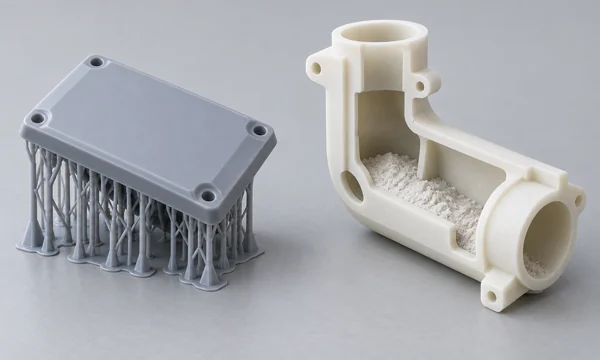
SLS and MJF avoid many support-contact problems, but loose powder must be removed. A hollow housing or internal duct needs a practical cleaning route. An opening may look adequate in the CAD model yet leave an internal corner inaccessible. Review escape openings and cleaning access before approving the design; Formlabs’ SLS design guide addresses enclosed cavities and shows why its recommendations depend on geometry and material.
Dyeing, smoothing or painting can change the appearance of a powder-printed part. Agree on that finished condition early, including how small details and mating features will be checked afterward. A photograph of an unfinished sample tells you little about the surface the quotation actually includes.
How should you compare SLS with MJF?
SLS uses a laser to process the selected area of each powder layer. MJF deposits fusing and detailing agents, then applies thermal energy to form the layer. HP’s comparison of SLS and MJF explains the different mechanisms. Neither description supplies a universal answer about which will cost less or fit better on your part.
If nylon suits the application, request both routes against the same released model and acceptance requirements. Compare the quoted material grades, delivered finish, critical dimensions and available evidence. The same nominal material family is useful context, but the quotations may still describe different finished parts.
Quantity matters alongside part size and build arrangement. Ask for the intended order quantity and likely repeat quantities, with cleaning, finishing and inspection included. Compare the delivery date for usable parts rather than the printer’s running time alone. Cooling and post-processing belong in the schedule, and the supplier’s current build plan affects it.
Which process fits these common jobs?
| What the part needs to do | Routes worth reviewing | Evidence to request before approval |
|---|---|---|
| Show the appearance of a small product cover | SLA with an appropriate resin and finish | An agreed visible surface and acceptable support marks |
| Check a housing through repeated assembly | SLS or MJF nylon; a suitable engineering resin may also merit testing | Fit results and checks on the features used during assembly |
| Flex as a clip or latch | A grade with suitable strain and fatigue behavior | A test of the actual geometry at the required deflection and cycle count |
| Form a hollow duct or enclosed passage | A process compatible with the geometry and cleanup access | A defined way to remove resin or powder and inspect the passage |
| Locate another part with a critical bore or mating face | Printing with agreed secondary work, or another manufacturing route | A drawing, measurement method and finished-part acceptance criteria |
For each application, agree on the material grade and the sample tests needed to assess the relevant features.
Specify fit before the part is printed
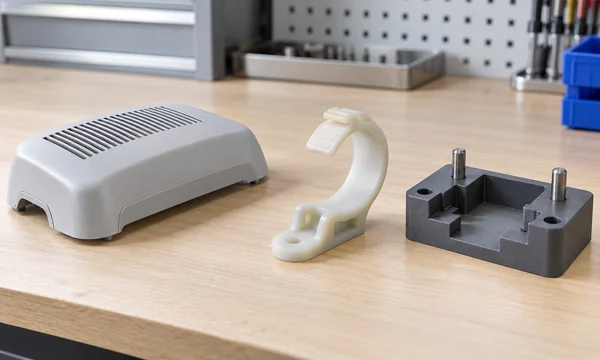
Layer height is not a tolerance specification. Put important dimensions on a drawing and identify the mating component or datum relationship. Ask the supplier to assess those features on the proposed process, material and geometry. There is no single tolerance value that covers every SLA, SLS or MJF part.
State the finished condition in which dimensions will be inspected. If a locating bore needs reaming or a mating face needs machining, include that operation in the quote. Our CNC machining vs. 3D printing guide can help when the required material or interface points toward a machined prototype.
For repeat orders, approve a representative sample against the drawing and the intended use before releasing the batch. Record the material and finished condition with the results. The first article inspection guide covers how to define that approval and the evidence to retain.
What should go in a 3D printing RFQ?
Send the CAD model or a suitable print-ready mesh with its revision and units. Add a drawing where dimensions, surfaces or acceptance criteria need to be controlled. Our manufacturing RFQ checklist covers the broader file package.
For a useful SLA, SLS or MJF comparison:
- Explain whether the part is for appearance, fit checking, functional testing or end use.
- Give the exact material grade if it is fixed. Otherwise, describe the required behavior and the exposures the part will see.
- State quantities, repeat-order expectations and the date finished parts are needed.
- Mark critical fits, cosmetic faces and any surfaces where support contacts or finishing changes would be a problem.
- Include loads, temperature, repeated-use requirements and any test the printed part must pass.
- Define the delivered finish, inspection records and sample approval needed before a batch proceeds.
If the process is still open, say so. The supplier can then assess the design against the required result instead of quoting a process name with unanswered assumptions.
Frequently asked questions
1. Is SLA only suitable for visual prototypes?
No. Engineering resins can suit functional components or tests when the selected grade and processing conditions meet the requirements. Check the material data and test the relevant part features.
2. Is MJF always stronger than SLS?
No universal ranking applies. Compare the exact materials, build conditions and property needed for the design. A strength value alone may not answer a question about stiffness, impact or repeated flexing.
3. Are PA12 parts made by SLS and MJF interchangeable?
Not automatically. Confirm the grade, dimensions, finish and performance requirements before approving a process change. Use representative samples where fit or function depends on the result.
4. Do SLS and MJF parts need supports?
They generally use the surrounding powder for support rather than dedicated structures. Cleaning access is still necessary, especially for enclosed cavities and internal passages.
5. Which process gives the smoothest surface?
SLA is a useful starting point when fine detail and a smooth surface are priorities. Support placement and finishing affect the result. Compare samples in the same delivered condition if powder-printed parts will be smoothed or coated.
6. Can I use one design for all three processes?
You can submit the same model for review, but support access, powder removal, thin features or fit requirements may call for changes. Have proposed changes approved before the build starts.
7. Which process is cheapest for a small batch?
Request quotations for the actual model, material and quantity. Include finishing and inspection. A process that has a lower printing price can need more work before its parts are ready to use.
To compare routes for your design, send the model, quantity and acceptance requirements through Zenbot’s 3D printing quotation form. Identify the features that must work so the review can address them directly.

About Zenbot Team
Zenbot Team creates manufacturing and procurement resources for Zenbot China. Our guides cover CNC machining, sheet metal fabrication, 3D printing, injection molding, PCBA, and RFQ preparation, helping engineers and purchasing teams compare options and define project requirements. Technical feasibility, specifications, pricing, and lead times require project-specific confirmation.